

Projects in our carbon database, and counting!

Carbon Data
- Home
- Carbon Data
Curtins' Embodied Carbon Data
Sharing embodied carbon data supports our commitment to open knowledge sharing, collaboration, and whole‑life carbon assessment, helping to build a stronger evidence base across the industry.
By making this information transparent, we can accelerate the adoption of low‑carbon solutions, enable benchmarking, and position carbon performance as a key measure of project success.

Data Boundaries (2025/2026)
The embodied carbon data below is for key sectors for the year 2025/2026, and the data boundaries include:
New build projects superstructure only on varying construction types.
Upfront carbon (lifecycle module A1-A5) with no uncertainty factor applied.
Typically, the calculation uses industry standard embodied carbon factors which allow for an average consumption of material manufacture types and where provided within projects EPDs.
This data can be used as a point of reference for understanding the scale of carbon we typically see for superstructure types across the business in each sector.
Commercial: Offices
Number of projects in dataset: 8
Industry EC limits (where applicable):
UKNZCBS 2030 Target: 48% Whole Building Target – 264kgCO2e/m2
Average embodied carbon: 196 kgCO2e/m2
Education: Further Education
Number of projects in dataset: 7
Industry EC limits (where applicable):
UKNZCBS 2030 Target – 30% Whole Building Target – 144kgCO2e/m2
Average embodied carbon: 288 kgCO2e/m2
Education: Higher Education
Number of projects in dataset: 7
Industry EC limits (where applicable):
UKNZCBS 2030 Target: 30% Whole Building Target – 144kgCO2e/m2
Average embodied carbon: 128 kgCO2e/m2
Education: School
Number of projects in dataset: 11
Industry EC limits (where applicable):
CF 25 - Upfront (A1-A5) Embodied Carbon Target: Total 350 kgCO2e/m2 (frame, floors, roof, substructure 1m bgl)
UKNZCBS 2030 Target: 30% Whole Building Target – 118kgCO2e/m2
Average embodied carbon: 150 kgCO2e/m2
Healthcare: Hospital General
Number of projects in dataset: 6
Industry EC limits (where applicable):
UKNZCBS 2030 Target: 48% Whole Building Target – 283kgCO2e/m2
Average embodied carbon: 212 kgCO2e/m2
Industrial
Number of projects in dataset: 4
Industry EC limits (where applicable):
n/a
Average embodied carbon: 165 kgCO2e/m2
Residential
Number of projects in dataset: 24
Industry EC limits (where applicable):
UKNZCBS 2030 Target: 48% Whole Building Target – 208kgCO2e/m2
Average embodied carbon: 245 kgCO2e/m2
Highlights
Year Curtins set embodied carbon targets
kgCO₂e/m² = average 2025 EC in carbon database
Low Carbon Schemes


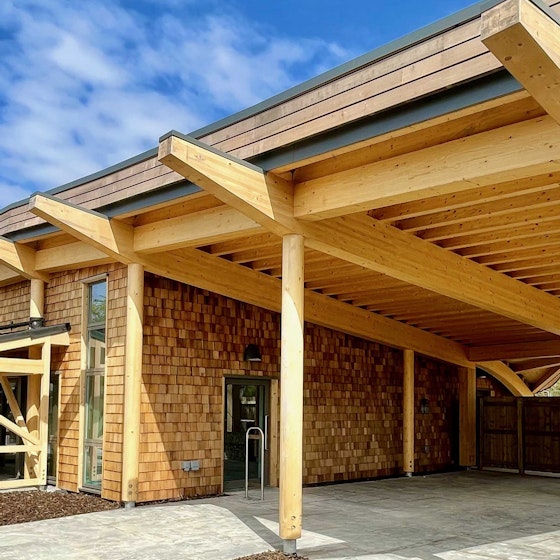
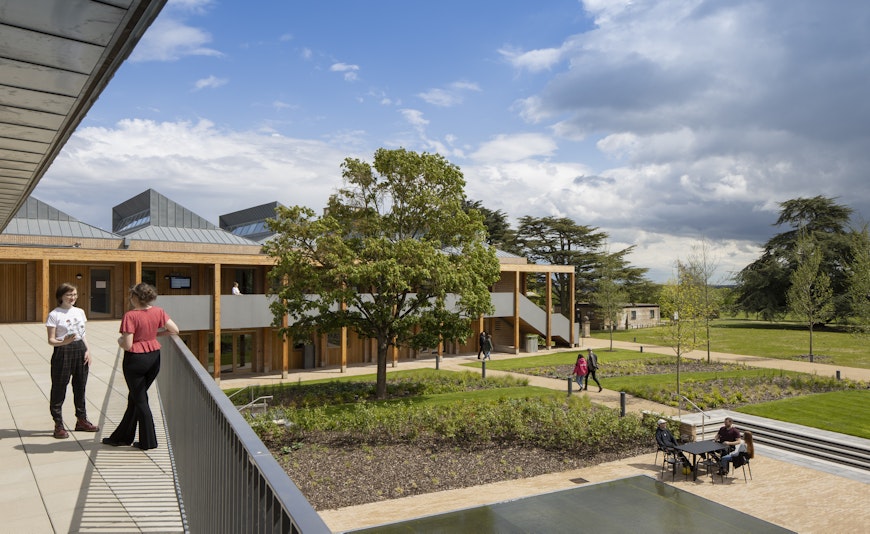
A new-build Visitor Centre with internal and external spaces to educate local school children and day trip visitors.
Earth Trust Lab, Oxfordshire

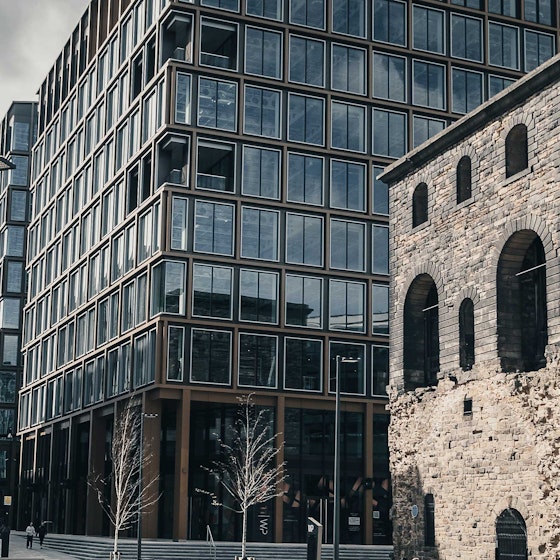
11 & 12 Wellington Place is a 12-storey office building that forms part of the 140,000sqm mixed-use development in central Leeds.
11&12 Wellington Place, Leeds

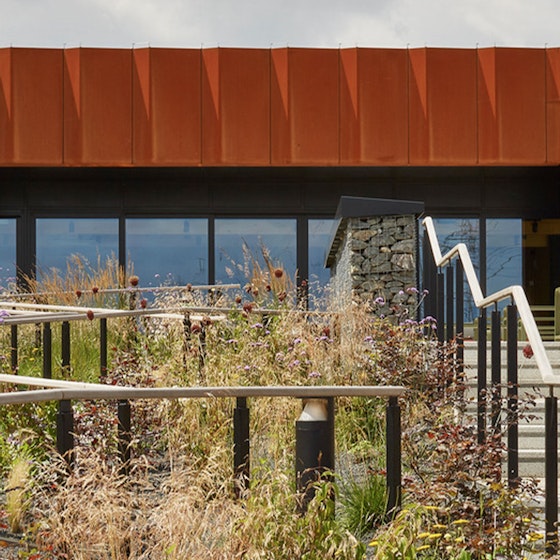
The Wilds at Barking Riverside is a multi-purpose community, ecology and events space with state-of-the-art pneumatic waste collection facility.
The Wilds Ecology Centre, London
Reducing Carbon Emissions for a Sustainable Future
We’re committed to making meaningful, measurable change, both within our own operations and across the wider industry. By leading, collaborating, and sharing best practice, we aim to maximise the positive impact we can make together.
We measure the carbon emissions of both our projects and our business to fully understand our footprint. Through detailed analysis and transparent reporting, we’ve set ambitious but achievable reduction targets.
Our goal is to reduce the average embodied carbon of our projects from 340kgCO₂e/m² to 295kgCO₂e/m² by 2030. As of 2026, we are exceeding this target.
By working proactively towards these targets, we’re helping to drive environmental improvement and move towards a more sustainable, resilient future for everyone.