 Projects
- Home
- News & Views
- Project Update | Capital Building, Liverpool
Capital Building, Liverpool
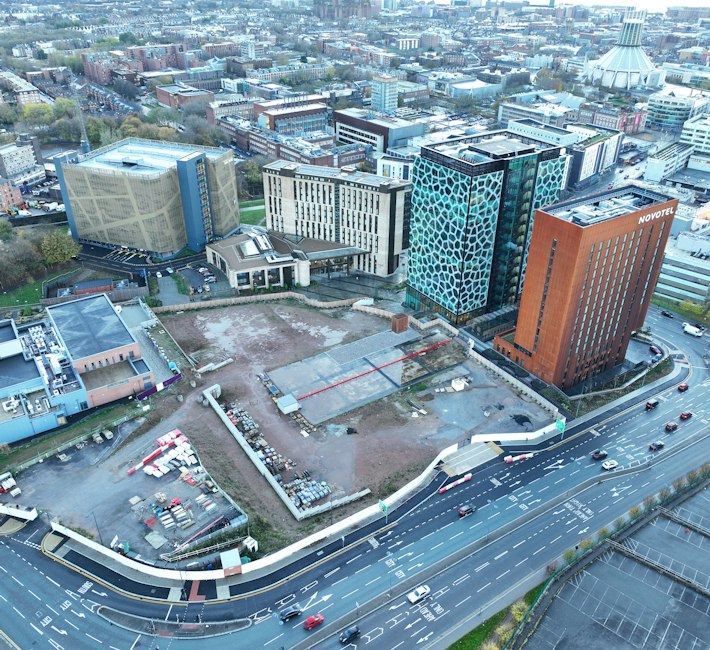
Known locally as the ‘Sandcastle’, The Capital is the largest office building in Liverpool. Located within the Central Business District, it now provides high-quality Grade A office and commercial space.
Originally constructed in 1976 as the headquarters for the Royal Insurance Co., the building has undergone significant adaptation over the last 25 years. A key milestone in its evolution was the creation of City Exchange in 2000, introducing a landmark atrium and three-level concourse that redefined the building’s functionality and user experience.
How to approach existing buildings
A central principle of our Insite approach has been to fully understand the existing structure before intervention, enabling informed decision-making and minimising unnecessary strengthening works. This was demonstrated in 2015, when we were commissioned to undertake a feasibility study to extend the mezzanine terrace floors across an active Tesco Express and service access below.
Through targeted desk studies and intrusive investigations, we identified an opportunity to deliver approximately 1,300m² of additional office space without requiring strengthening to the primary frame, maintaining retail operations and reducing cost, programme, and disruption risks.
Building on this success, our role expanded to encompass a comprehensive programme of structural assessments, interventions, and enhancements aligned with the building’s long-term asset strategy. This has included the development of structural risk assessments to evaluate the condition and performance of the reinforced concrete frame across all levels, providing the client with clear, evidence-based guidance for investment and maintenance.
Flexible adaptation
Our interventions have consistently focused on enabling adaptation while respecting the constraints of the existing structure. This has included the modification of precast concrete façade panels to accommodate new window installations, improving daylighting and occupant experience, and the integration of new MEP systems within constrained plant room and rooftop environments.
A key example of innovation driven by constraint is the design and implementation of bespoke steel mezzanine connection details, developed to efficiently transfer loads into the existing bowstring façade columns. These solutions required a detailed understanding of load paths, constructability, and the limitations of the original structure, ensuring compatibility while maximising additional lettable floor area.
We look forward to continuing to support the 'Sandcastle' as it evolves for years to come.
Reusing an existing building?
Explore our Insite service - the starting point for any existing building.
More on Insite Events

 Views
Views